Current events
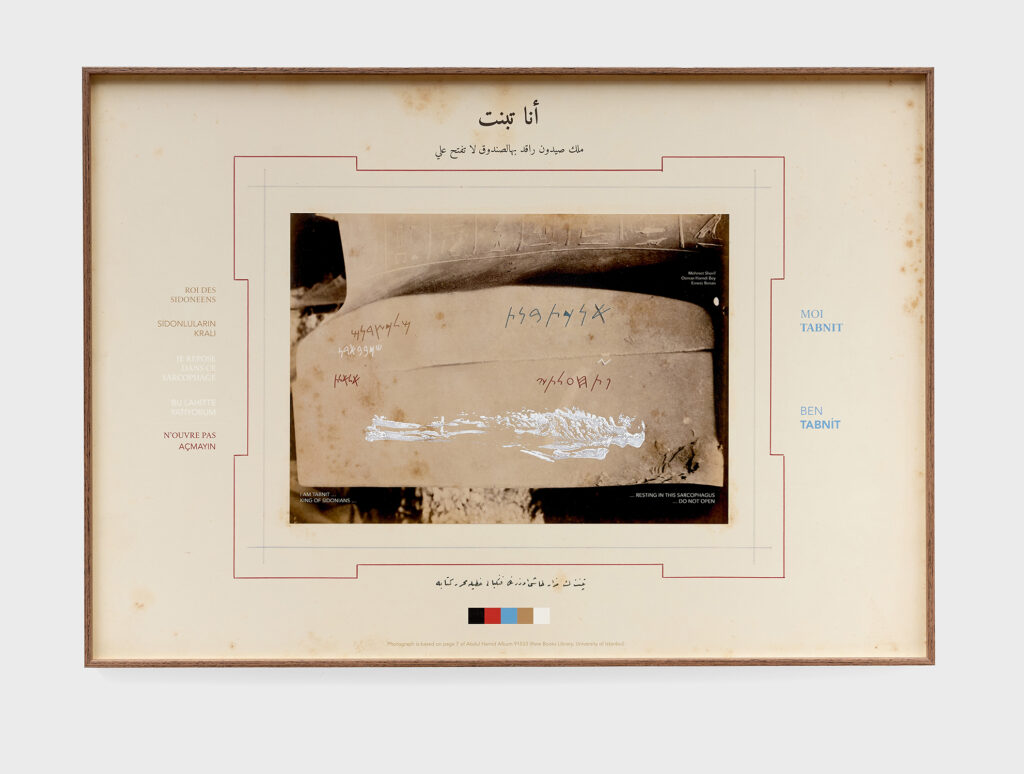
I, Tabnit, 2024, © Akram Zaatari, exhibition view of Father and Son at Thomas Dane Gallery, 2024.
Thesis defense: Akram Zaatari Father and Son : Restitution in Creative Practice
25 of November 2026, 9 am – 1pm
At Bibliothèque Kandinsky, Maison Pompidou, Salle constellation, 50 rue Rambuteau, 75003 Paris
PhD in Arts under the direction of François Pernot ; CY Cergy Paris University, Bénédicte Savoy (Technische Universität Berlin) and the professional framing of Alejandra Riera – ENSAPC
Father and Son : Restitution in Creative Practice examines restitution as both a mode of inquiry and an artistic practice. Taking as its point of departure the Phoenician sarcophagi of Kings Tabnit and Eshmunazor II – excavated in Sidon in the nineteenth century and removed respectively to the Istanbul Archaeology Museums and the Louvre – the dissertation examines how archaeology shaped the modern museum, contributed to the formation of the discipline of the beaux-arts, and participated in the construction of national and imperial historical narratives.
Rather than advocating the physical return of displaced objects, the dissertation explores alternative forms of restitution enacted through artistic practice. The works produced for the exhibition Father and Son restore relationships rather than possessions, reconstructing lost objects and histories, recovering overlooked voices, and re-establishing connections fractured by rival quests to claim the past through excavation and removal. Restitution thus becomes less a matter of returning objects than a mode of inquiry through which new historical relations and forms of knowledge can be produced.
By approaching restitution as an artistic process and an ethical position rather than as the settlement of claims, the dissertation proposes art as a space in which restitution can be rethought, and where unresolved histories can be revisited, performed, and reimagined beyond the logics of possession, territoriality, and state interest.
—
Born 1966 in Lebanon. Akram Zaatari lives and works in Beirut.
Akram Zaatari has produced more than fifty films and videos, a dozen books, and countless installations of photographic material, all sharing an interest in writing histories, in the production and circulation of images in times of war, and the play of tenses inherent to various letters that have been lost, found, buried, discovered, or otherwise delayed in reaching their destinations. The act of digging, or the excavation itself, has become emblematic of his search for objects, narratives and missing links, while trying to restitute lost connections across time and geography.
Zaatari has played a critical role in developing the formal, intellectual, and institutional infrastructure of Beirut’s contemporary art scene. He is a co-founder of the Arab Image Foundation, a groundbreaking, artist-driven organization devoted to the research and study of photography in the Arab world. He has made invaluable and uncompromising contributions to the wider discourse on preservation and archival practice.
Zaatari’s work has been featured at DocumentaVenice Biennial 13 in 2012. He represented Lebanon at the Venice Biennale in 2013.
His films include three features : The Landing (2019), Twenty-Eight Nights and A Poem (2015) and This Day (2003).
His work is part of institutional collections such as Art Jameel, Centre Pompidou, Guggenheim Museum NY and Abu Dhabi, Hammer Museum, Moderna Museet, K21, MACBA, MMCA Seoul, MoMA, Sharjah Art Foundation, Serralves Foundation, Tate Modern, and Walker Art Center.
Eurotéléport
26.01 > 31.01.2026
Exhibition and thesis defense by Nataliya Ilchuk
At Film Gallery, 43, rue du Faubourg Saint-Martin
75010 Paris France
Thesis defense : 26 January 2026 – 2pm
Eurotéléport, an exhibition by Ukrainian artist and filmmaker Nataliya Ilchuk (b. 1985, Lviv) bringing together film projects, a series of photographies, and selected materials from her personal archive, addressing questions of migration.
Eurotéléport speaks of Ukrainian economic migration to Europe and brings together a series of films and videos produced by artist and filmmaker Nataliya Ilchuk (b. 1985, Lviv) over the last three years. These works focus on the themes of the contributory economy as opposed to the technological entropy of automation, particularly in the arts sector.
The exhibition explores the idea that migrant individuals, who, by virtue of their thanatological character, may in fact be the most alive and the most free, according to the theories of French philosopher Gilbert Simondon (1924-1989). Consequently, following the logic of freedom expressed through mobility, the question of collective identity disappears as soon as individual mobility begins.
After the collapse of the USSR, no Ukrainian collective identity emerged to replace the Soviet one. No conditions were created for a shared sense of belonging to a common cultural and historical heritage, and individual identity could only manifest itself for those who could feel freedom of self-fulfilment, freedom of expression and freedom of movement.
The main categories thus became underground artists and migrant workers, individuals who could only rely on themselves, who did not form trade unions, and who did not even maintain close contact with each other, unlike the early 20th century, when the diaspora of the first waves of migration left Ukraine in families, or the post-2022 migration of women with children fleeing the war. Ukrainian migration in the 1990s and 2000s was almost entirely solitary, and Eurotéléport reflects of this alienation and isolation passed down from one generation to the next.
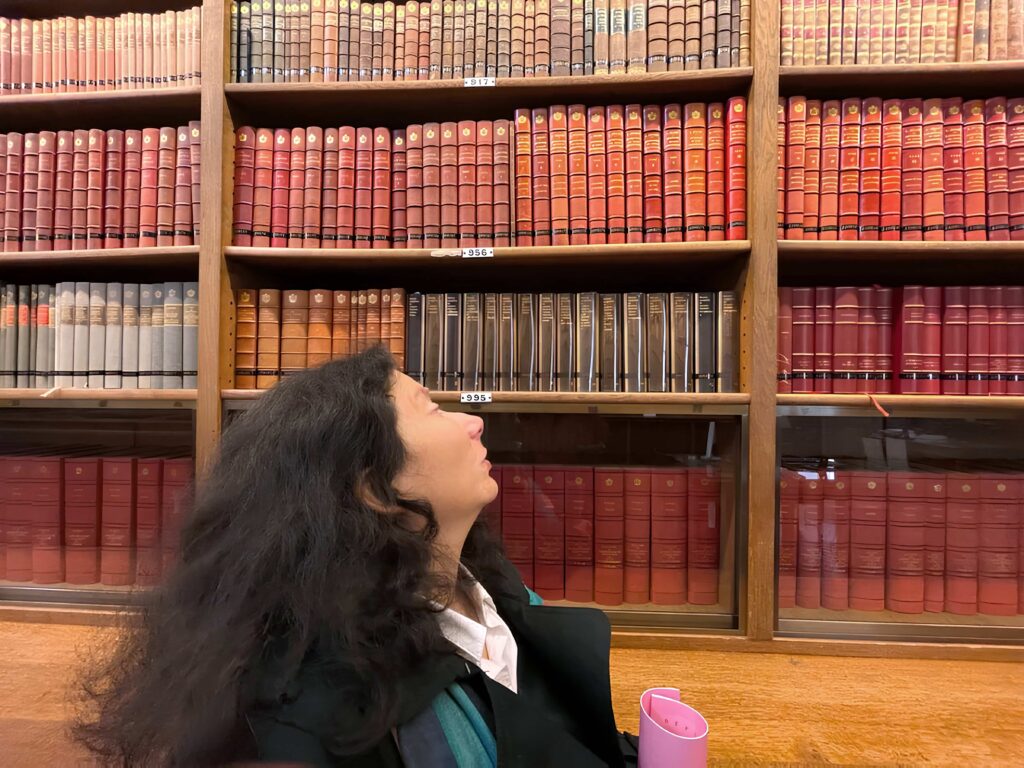
Tania Vladova, nouvelle chercheuse HDR à l’ENSAPC
[This text hasn’t been translated]
Tania Vladova enseigne l’esthétique et écrit sur l’art. Habilitée à diriger des recherches (Paris Sorbonne, 2024), elle est docteure de l’EHESS, professeure d’esthétique à l’École supérieure d’art et design de (ESADHaR) – Rouen, et actuellement chercheure invitée au sein de l’École universitaire de recherche « Humanités, création, patrimoine » à Cergy Paris Université et à l’ENSAPC. Ses recherches portent sur la théorie des images et sur les rapports entre art et savoir. En 2026-2027, elle travaillera avec les doctorant·es de l’ENSAPC au développement du Laboratoire de Recherche en Arts LaRA, ainsi que sur la Carte blanche de la recherche, un programme de présentations publiques des travaux de nos doctorant·es.