2025
FREE TO MOVE FROM CHAIR TO CHAIR
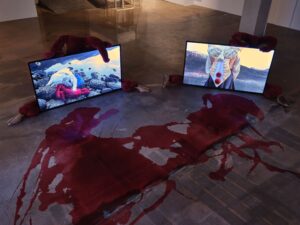
A group exhibition at Centre d’art Ygrec-ENSAPC
From September 20 to November 15
Opening on September 20 from 5-9pm
With : Guillaume Maraud, Irma Name, David Posth-Kohler, Julie Sas and Angharad Williams
Curated by : Ana Braga, Clara Guislain and Guillaume Breton
Free to move from chair to chair is a group exhibition bringing together works around plural and unconventional approaches to education and pedagogy. Echoing contemporary art’s “educational turn” [1] (while stepping aside from its didactic rhetoric and utopian stances), the six selected artists, through oblique or fragmentary means, explore the role of education as an intimate experience, as an apparatus, a conditioning, or a socio-political stake with multiple ramifications. Education, marked by processes of transition and thresholding, extends well beyond physical and institutional boundaries. Far from the limits of the classroom, it is considered here as a space crossed by conflict and transformation, which involves the political sphere, subjectivity, the construction of self-image and collective memory.
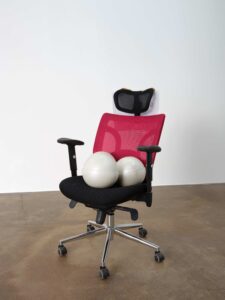
“Free to move from chair to chair” [2] is a quotation taken from a conversation between Robert Filliou and John Cage on the topic of education. In this talk, Cage describes a learning situation characterised by radical flexibility, both in its spatial arrangement (an empty room without assigned seats where one would be “free to move from chair to chair”) and in its content (“nothing is learned that was not already known or knowable before the advent of the learning situation”).
NEGO FUGIDO, QUILOMBOLA MEMORIES
Monographic exhibition curated by Nicola Lo Calzo at the Centre d’art Ygrec-ENSAPC
From June 5 to July 12, 2025
Opening June 5, 2025 from 7 to 9 p.m.
Ashes and fire
Nicola Lo Calzo’s exhibition, Nego Fugido, Quilombola memories, offers a sensitive and committed immersion into a process of reaffirming freedom.
Every year, in the Quilombola community [1] of Acupe, Brazil, the Nego Fugido takes place: a ritual performance that re-enacts the dehumanization of slavery and the struggle of enslaved subjects for emancipation. Like tableaux vivants, this mise en scène brings to life an embodied memory of oppression and resistance from the point of view of those who had been subjugated.
Contrary to the dominant narratives, Nego Fugido constructs a sovereign counter-narrative, which is carried by those whose history has long been denied or erased. Through this practice, the community reappropriates its past, revisits it in the light of the present, and proposes a more complex reading of its colonial heritage, which is still alive in Brazil as it is elsewhere. The performance of Nego Fugido thus acts as an act of memorial mediation, at the crossroads of art, politics, spirituality and transmission. And collectively asks us: What voices shape our historical memory? Who decides which narratives form the basis of a nation?Through exhibiting this practice, the artist-researcher Nicola Lo Calzo reveals an often unspoken aspect of history: a memory that is not fixed, that is not written down in books, but which is expressed through bodies, gestures, songs and rituals. This series is part of the KAM project, which was initiated in 2010. This project explores Atlantic memories of slavery and the forms of resistance that emerged from them…
LES AVANT-CHOSES PRÉ-HISTOIRE D’UN LIEU
Group Show
From the 5th of February to 17th of May 2025
Opening 1rst February 2025, 5pm to 9pm
With : Lorena Almario Rojas, Dylan Altamiranda, Emma Bougaeff, Paul Caillard, Lou Dalifard, Emma Fleury-Cancouet, Kwama Frigaux, Elias Galindo Lopez, Louise Guegan, Myriam Houri, Lou-Pepita Iribarne-Carpentier, Soli Jeon, Yeongseo Jee, Shumeng Li, Gaëtane Martinot, Luciano Ortiz, Elea Roussel, Camille Simon Baudry, Greta Tessitore, Yu-Wen Wang.
Curators : Alejandra Riera, Laurence Vidil, Samuel Garland et Nicolas Charbonnier.
[this text hasn’t been translated yet]
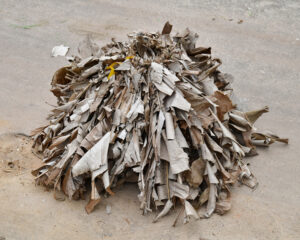
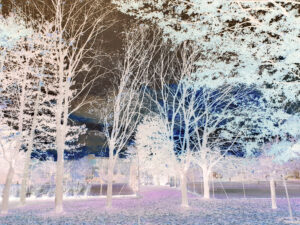
De l’automne 2020 à l’hiver 2024, nous avons rencontré un lieu que nous avons nommé, assez vite : la parcelle [1]. Se concentrer sur ce qui était peu observé —une parcelle de terre délaissée, peuplée en arbres et végétaux qui poussaient inlassablement autour des grilles de deux terrains de tennis à l’accès libre, et même sur les sols d’un parking entrecoupé par les longues allées des tilleuls—, a permis de créer un temps autre, presque suspendu, rêvé. Et d’approcher en même temps l’existence et la réalité propre de ce lieu-parcelle, tout comme celle de son passé paysan, d’une terre d’un village rural enseveli sous une cité administrative. Nous avons ainsi arpenté à différentes saisons de ces quatre années, ses quelques 7000 m² de terre où le coucher du soleil pouvait encore être apprécié depuis le parc adjacent et où les ombres d’arbres —des plus anciens au plus jeunes—, procuraient leur fraîcheur.
WHO PUT BELLA IN THE WITCH ELM?
Exposition collective au Centre d’art Ygrec-ENSAPC
Du 04.12.2024 au 18.01.2025
Vernissage samedi 30 novembre de 17h à 21h
Avec : Mathis Collins, Raphaël Delannoy, Léontine Deslandes, Sveva Diolaiti, Gral et Isadora Guzniczak.
Commissariat : Gral
Le Centre d’art Ygrec donne ses clés à un groupe d’artistes et étudiant·es issu·es de l’ENSAPC pour construire un projet de A à Z : iels assument à la fois la création de leurs œuvres, le commissariat, le montage et la médiation de l’exposition.
Celle-ci a pour origine un fait divers : au creux d’un arbre planté au milieu de la campagne anglaise du Worcestershire, le cadavre d’une femme est découvert un matin d’avril 1943. Bientôt, des graffitis anonymes apparaissent sur les murs du village voisin, répétant cette même question un siècle durant : « Who put Bella in the Wych Elm? » (Qui a mis Bella dans l’orme aux sorcières ?) Par le mystère qui les entoure et le contexte rural dans lequel elles se situent, ces inscriptions évoquent les possibilités horrifiques du folklore, point de départ d’une exploration que cette exposition se propose de faire à travers l’héritage artistique du cinéma d’épouvante. En effet, à défaut de pouvoir retrouver le meurtrier de Bella, les artistes qu’elle réunit se font l’écho de la charge transgressive du « folk horror », genre filmique fantasmant un retour au paganisme et confrontant nos sensibilités modernes à des communautés isolées aux curieuses croyances. Dès lors, les œuvres de cette exposition proposent un folklore sombre qui s’assume comme outil politique de provocation et de bouleversement, esquissant les paysages d’un nouveau système où la nature et les corps dansent sur les ruines du vieux monde.